
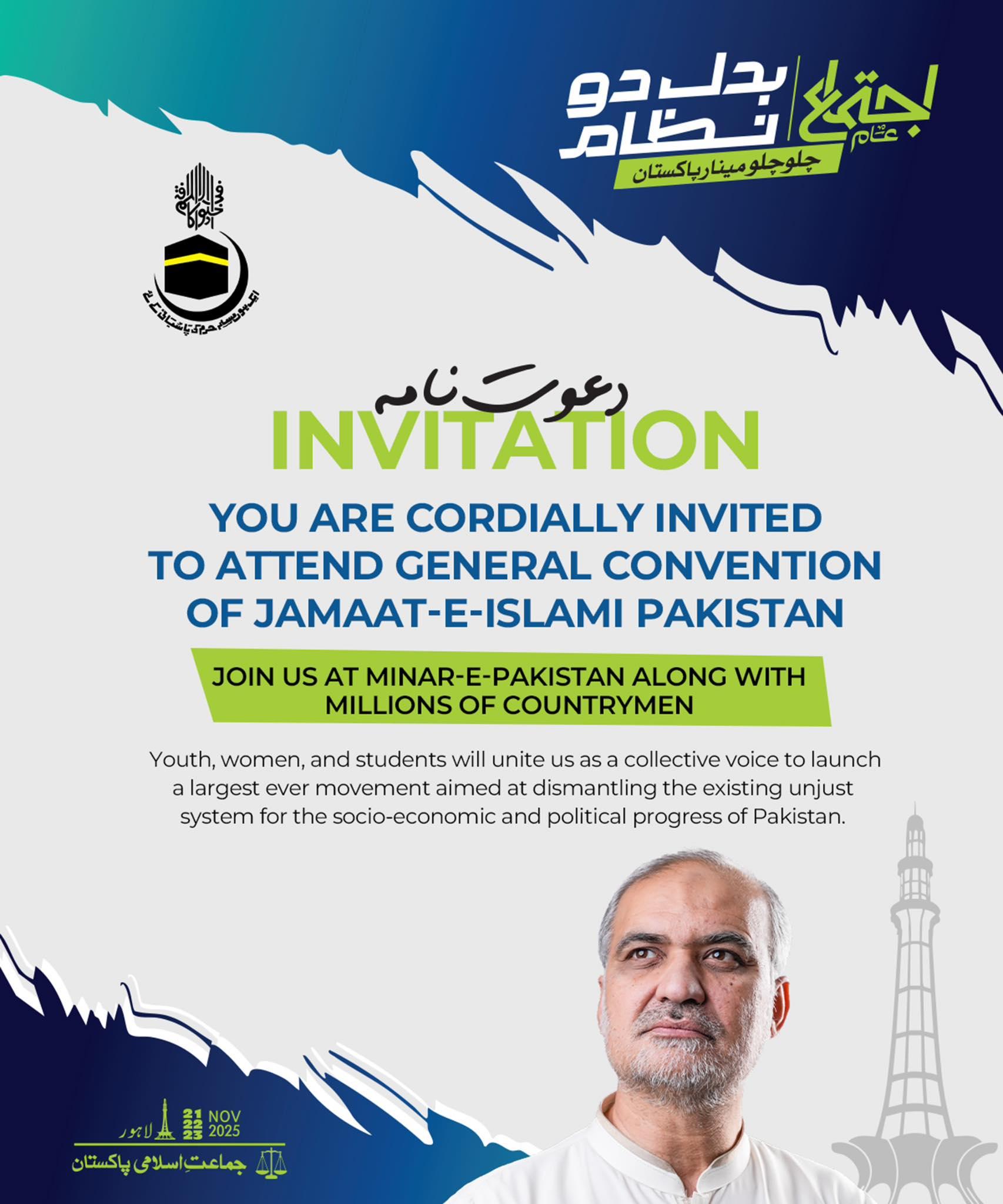
Published on 17 November 2025
Come to the Ijtema e aam
Commitment to Religion and the Blessing of Serving the Faith
Commitment to religion and the ability to serve the faith are among the best blessings granted by Allah Almighty. Allah has bestowed this honor upon many Muslims around the world, both individually and collectively. Among these blessed caravans, one esteemed caravan is known as Jamaat-e-Islami, which is recognized throughout the world.
Jamaat-e-Islami, in its mission and struggle to achieve its destination, is an organized movement that strives to follow the obedience of the noble Prophets (peace be upon them), the path of the companions (may Allah be pleased with them), and the footsteps of the righteous predecessors.
Jamaat-e-Islami was established 85 years ago on 26 August 1941 in Lahore. Today, it holds deep influence and presence throughout South and Southeast Asia, including Pakistan, India, and Bangladesh. When this caravan began its journey under the leadership and call of Maulana Maududi (may Allah have mercy on him), only 75 individuals were part of it. However, their sincerity and religious passion laid such a firm foundation that gradually this caravan assumed a global form and has been leaving deep marks in the world of thought and action.
At the time of the organization’s founding, the treasury could hardly be established with only 74 rupees. Yet neither the lack of financial resources nor the shortage of manpower became an obstacle. These devoted workers of Islam spread across the entire subcontinent. Over time, the awareness of Jamaat’s objectives and the collective effort of workers committed to its strategy became active across various parts of the world. Through the struggle for establishing the religion of Allah, millions of men and women, young and old, are striving to seek Allah’s pleasure and follow the path of His last Messenger (peace be upon him).
Many people accepted the message of Islam presented by Jamaat-e-Islami and joined it practically. A second large group appreciated the message but could not decide to associate themselves with the Jamaat. A third group chose to obstruct its path through allegations, accusations, and oppression. For all of them, we pray for goodness and well-being. Despite these varying reactions, Jamaat-e-Islami today stands as a reference point in the world—for goodness, construction, truth, service, sincerity, and trustworthiness. This very Jamaat’s Pakistan General Meeting is being held on 21-23 November 2025 in Lahore.
The Present Challenges and the Significance of the Ijtema
The Muslim Ummah today is facing crises, hardships, and new forms of slavery. In such circumstances, this Ijtema can open life-giving pathways. The homeland is surrounded by internal and external threats, and this Ijtema can provide a unified spirit of action. It can reveal the reality of political instability, economic corruption, and unconstitutional governance. It can also expose the ideological and intellectual destruction being carried out through certain NGOs and the “sweet poison” being spread against Islamic Shariah through so-called religious scholars and reformists. This Ijtema can provide a method to stay aware of this intellectual apostasy.
The future brings intellectual, academic, and theological challenges with its onslaught. Awakening the awareness of this destruction is the first necessity. To respond to it by entering the field of action is the second necessity. And beyond action and reaction, presenting a complete system of thought and strategy is the third and most important necessity.
Gatherings and meetings of other groups often involve religious or political uproar, but Jamaat-e-Islami’s General Ijtema is held with a distinct style and an exceptional dignity. Explaining the importance of the central Ijtema in the organizational life of Jamaat, Maulana Maududi (may Allah have mercy on him) said at the first All-India Ijtema held in Dar-ul-Islam on 19 April 1945:
“By enduring the difficulties of travel in this harsh era and gathering here from different corners, you have strengthened my power as well as your own. Had you not done so, I would have grown weak in my place and so would you. As a result, this movement—which is an expression of a great resolve—would have frozen. When you choose a person as your leader for a great cause and obey him, you strengthen your own power. Your lack of obedience weakens the Jamaat. Conversely, the more your hearts and minds are dominated by the purpose, and the more obedience you show for its sake, the stronger your center becomes and the greater your organizational strength.”
Maulana further emphasized: – You endured financial, travel, and health difficulties to gather here. – In doing so, you strengthened the organization, the Jamaat, and yourselves. – This demonstrated your commitment to the great objective. – And through obedience to the organization, you increased the power of the mission.
This is the spirit under which the members of Jamaat respond to the call of the organization and participate in the Ijtema, strengthening not only the organization but themselves as well, InshaAllah.
Purpose and Benefits of the Ijtema
Jamaat-e-Islami strives, in the light of the Qur’an and Sunnah, to establish an Islamic society and an Islamic state. For this purpose, smaller organizational meetings at different levels continue as a routine, serving as means of harmony, development, training, and multidimensional expansion of the Jamaat. However, the national-level General Ijtema becomes a powerful manifestation and source of intellectual, spiritual, ideological, and organizational renewal. It is expected to yield numerous benefits:
– After the Ijtema, notable ethical, spiritual, practical, and ideological transformation appears in the lives of workers. – It deepens the connection with the Creator and renews the commitment to follow Prophet Muhammad (peace be upon him). – It guides workers in addressing the challenges faced by the mission today. – It highlights obstacles to implementing the Islamic system and proposes possible solutions. – It reminds workers of their responsibilities under Islamic teachings. – It recharges determination for preaching, societal reform, and organizational commitments. – It strengthens unity of thought and collective harmony. – Youth, men, and women from families, neighborhoods, towns, and cities attend and become assets for the future of the faith and the movement. – People from various intellectual, social, and professional backgrounds participate, meet, and ignite ambitions for building a better future. – The Ijtema provides direction to participants regarding national, communal, and global realities. – It is not a display of political power but a manifestation of comprehensive Islamic life, understanding, and discipline. – The Ijtema teaches sacrifice, patience, brotherhood, remembrance, humility, endurance, and preparation for meeting Allah.
In other words, Jamaat-e-Islami’s General Ijtema is not an ordinary gathering—it is a spiritual and revolutionary reflection of Islamic civilization and culture. Therefore, every worker must prepare themselves and their families consciously for participation.
Maulana Maududi’s Words on Discipline and Conduct
In April 1945, at a similar national Ijtema, Syed Maududi (may Allah have mercy on him) said:
“No matter how large your gatherings become, ensure that chaotic crowds, disorder, and noise never appear.
The work we have undertaken—reforming the world based on moral principles—requires us to prove ourselves the most righteous group in society.
Just as we criticize the world’s disorder, the world has the right to observe how we live individually and collectively, how we behave, how we gather, and how we manage our meetings.”
He warned that if the world were to witness disorder, noise, carelessness, and negligence within our gatherings, it would seek refuge from us. Therefore, he instructed:
“Display complete discipline, seriousness, cleanliness, and good conduct so that your gatherings become an example for the world. Rise and sit as an organized group, eat, gather, and disperse in an orderly manner. Wherever you gather, your honesty and trustworthiness must be visible. No one should need to guard their belongings; everything should remain safe without supervision.”
These words contain the best lesson for shaping the ethical and cultural character of the Ijtema and its participants.
Transforming the System
Syed Maududi (may Allah have mercy on him) further said:
“Our real need today is to change the entire system of life established by the British on the foundations of capitalism, imperialism, and materialism, which still exists in our country. As long as this system remains, no hardship, complaint, or problem can be fully resolved. The real cure is to replace this entire system with one based on Islamic ideological and moral foundations that guarantee social justice. When the system changes, justice will be established automatically, and people’s problems and complaints will be resolved.”
Participation in the Ijtema and all its proceedings is a prelude to replacing this outdated system. After the Ijtema, the workers’ return to their regions will, InshaAllah, become a symbol of clear strategy, awareness, resolve, and renewed enthusiasm.